
J Krishnamurti, 1895 – 1986
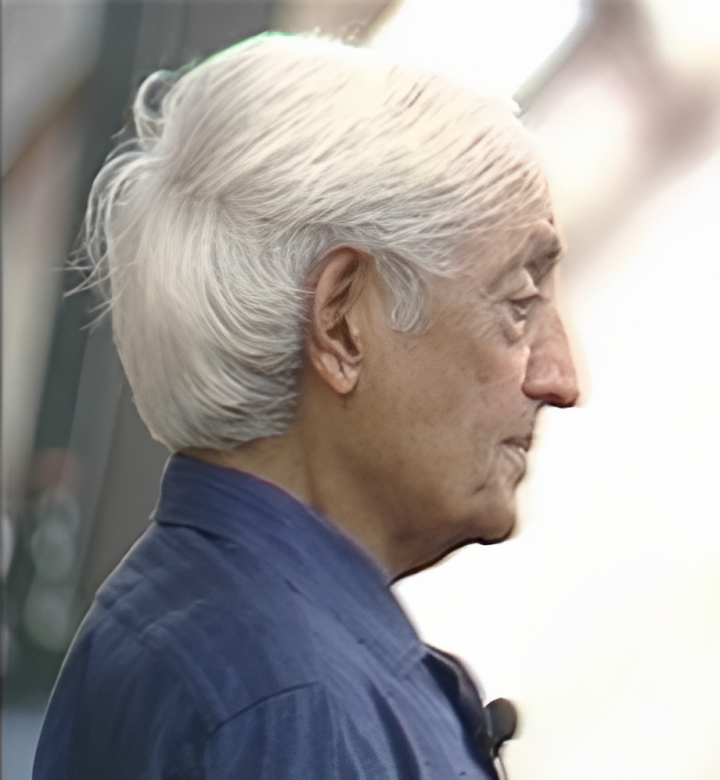
J. Krishnamurti was born in the midnight of May 11-12, 1895, at Madanapalle, a small village in Chittoor District of Andhra Pradesh in India. His father who was a revenue officer, moved with his family to Madras after his retirement. There Mr C. W. Leadbeater (CWL), an eminent theosophist who was clairvoyant happened to see Krishnamurti. Although there was nothing exceptional outwardly in boy Krishnamurti, CWL found that he had an exceptionally pure aura with not a spec of selfishness in it. On further investigation, CWL found that the boy was going to be a great spiritual teacher and will give new teaching to humanity. So in 1909, Krishnamurti was adopted by Mrs. Annie Besant, President of the Theosophical Society. She was convinced that he was to be a great spiritual teacher. Three years later she took him to England to be educated in preparation for his future role. An organisation called ‘The Order of the Star in the East’ was set up to promote this role and Krishnamurti was declared as its Head. Over the years, more than hundred thousand people all over the world became its members and donated money, property and wealth for the work of the World Teacher. In 1929, after many years of questioning himself and the destiny imposed upon him, Krishnamurti disbanded this organisation, turning away all followers and returning all the money and property to respective donors. He said:
“Truth is a pathless land, and you cannot approach it by any path whatsoever, by any religion, by any sect. Truth, being limitless, unconditioned, unapproachable by any path whatsoever, cannot be organized; nor should any organization be formed to lead or to coerce people along any particular path.”
He also said that his only concern was to set man absolutely and unconditionally free. From that time until his death on February 17, 1986 at the age of ninety, he travelled round the world speaking as a private person, teaching – giving talks and having discussions. Many of these talks have been published as books and audio-video recordings.
Krishnamurti evolved his unique teaching from his own being and living, for he had read no religious or philosophical literature. His aim was to set people psychologically free so that they might be in harmony with themselves, with nature and with others. He taught that mankind has created the environment in which he lives and that nothing can ever put a stop to the violence and suffering that has been going on for thousands of years except a transformation in the human psyche. If only a dozen people are transformed, it could change the world. Krishnamurti maintained that there is no path to this transformation, no method for achieving it, no gurus or other spiritual authorities who can help. He pointed to the need for an ever- deepening awareness of one’s own mind in which the limitations of the mind could drop away.
Krishnamurti was a World Teacher. Although born of Indian parentage, he stated repeatedly that he had no nationality and belonged to no particular culture or group. What he hoped his audience would learn, he himself lived.
Education had always been one of Krishnamurti’s chief concerns. If a young person could learn to see his conditioning of race, nationality, religion, dogma, tradition, opinion etc., which inevitably leads to conflict, then he might become a fully intelligent human being for whom right action would follow. A prejudiced or dogmatic mind can never be free. During his lifetime he established several schools in different parts of the world where young people and adults could come together and explore this possibility further in actual daily life.
Core of the Teachings
The following statement was written by Krishnamurti himself on October 21, 1980.
The core of Krishnamurti’s teaching is contained in the statement he made in 1929 when he said: “Truth is a pathless land”. Man cannot come to it through any organisation, through any creed, through any dogma, priest or ritual, not through any philosophic knowledge or psychological technique. He has to find it through the mirror of relationship, through the understanding of the contents of his own mind, through observation and not through intellectual analysis or introspective dissection. Man has built in himself images as a fence of security – religious, political, personal. These manifest as symbols, ideas, beliefs. The burden of these images dominates man’s thinking, his relationships and his daily life. These images are the causes of our problems for they divide man from man. His perception of life is shaped by the concepts already established in his mind. The content of his consciousness is his entire existence. This content is common to all humanity. The individuality is the name, the form and superficial culture he acquires from tradition and environment. The uniqueness of man does not lie in the superficial but in complete freedom from the content of his consciousness, which is common to all mankind. So he is not an individual.
Freedom is not a reaction; freedom is not a choice. It is man’s pretence that because he has choice he is free. Freedom is pure observation without direction, without fear of punishment and reward. Freedom is without motive; freedom is not at the end of the evolution of man but lies in the first step of his existence. In observation one begins to discover the lack of freedom. Freedom is found in the choiceless awareness of our daily existence and activity.
Thought is time. Thought is born of experience and knowledge which are inseparable from time and the past. Time is the psychological enemy of man. Our action is based on knowledge and therefore time, so man is always a slave to the past. Thought is ever-limited and so we live in constant conflict and struggle. There is no psychological evolution.
When man becomes aware of the movement of his own thoughts he will see the division between the thinker and thought, the observer and the observed, the experiencer and the experience. He will discover that this division is an illusion. Then only is there pure observation which is insight without any shadow of the past, or of time. This timeless insight brings about a deep radical mutation in the mind.
Total negation is the essence of the positive. When there is negation of all those things that thought has brought about psychologically, only then is there love, which is compassion and intelligence.
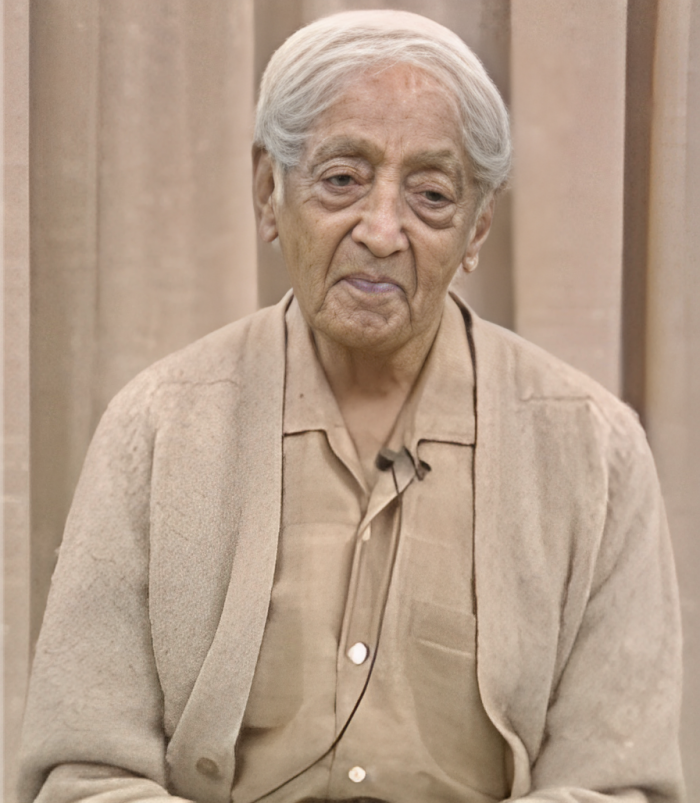
“If you want to spread these teachings, then live them; and by your life you will be spreading them, communicating them. This is much truer and more significant than mere verbal repetition.”
“I hope each one of us will face the actuality of our daily life and find out for ourselves if these teachings have any direct relationship to our life… And, if I may suggest, one should take these teachings as a whole, not take bits of it, what you like and reject the others, it is a total package, if I may use the modern word.”
“The teachings are not something out there in a book… You are not understanding the teachings but you are understanding yourself… The teachings are only a means of pointing, explaining… What the speaker is saying is acting as a mirror in which you are looking at yourself.”
“You won’t find another body like this, or that supreme intelligence operating in a body for many hundred years. You won’t see it again. When he goes, it goes. There is no consciousness left behind of that consciousness, of that state. They’ll all pretend or try to imagine that they can get into touch with that. Perhaps they will somewhat if they live the teachings.”